What Is Mindfulness? How to Be More Present in Your Everyday Life
Sep 09, 2026
"Do not dwell in the past, do not dream of the future, concentrate the mind on the present moment." ~ Buddha
When you hear the word mindfulness, what comes to mind?
Sitting cross-legged on a meditation cushion?
A perfectly quiet room?
Closing your eyes for 30 minutes while somehow managing not to think about your grocery list, the laundry, the email you forgot to send, or what you're making for dinner?
If so, I have some good news for you.
Mindfulness is much simpler than that.
At its core, mindfulness is the practice of intentionally bringing your attention to what's happening right here, right now, with openness rather than immediately judging the experience.
That's it.
And perhaps the most important word in that definition is practice.
Because your mind is going to wander.
You're going to start thinking about yesterday.
You're going to worry about tomorrow.
You're going to mentally write an email while someone is talking to you.
That's what minds do.
Mindfulness isn't about never getting distracted.
Mindfulness is noticing that you've left the present moment, and coming back.
Again.
And again.
And again.
We Spend So Much of Our Lives Somewhere Else
Think about how often your body is doing one thing while your mind is somewhere completely different.
You're taking a shower, but you're thinking about everything you need to accomplish that day.
You're driving to work while replaying a conversation from yesterday.
You're eating dinner while scrolling through your phone.
You're playing with your kids while mentally running through tomorrow's schedule.
You're lying in bed worrying about something that hasn't even happened.
Our bodies are here.
But our minds are somewhere else.
There's nothing inherently wrong with thinking about the past or planning for the future. Both are necessary.
The problem is when we spend so much time there that we miss the life happening right in front of us.
And that's where mindfulness comes in.
Mindfulness Doesn't Have to Mean Meditation
Meditation is a wonderful way to practice mindfulness.
But mindfulness and meditation aren't exactly the same thing.
Think of meditation as one way of strengthening your mindfulness muscle.
Mindfulness itself can happen almost anywhere.
You can practice mindfulness while drinking your morning coffee.
Instead of drinking it while scrolling through your phone, stop for a moment.
Feel the warmth of the mug in your hands.
Smell the coffee.
Take a sip and actually taste it.
You're practicing mindfulness.
You can practice while walking to your car.
Feel the ground beneath your feet.
Notice the temperature of the air.
Look at the sky.
Listen to the sounds around you.
Mindfulness.
You can practice while washing the dishes.
Feel the warm water.
Notice the bubbles.
Listen to the sound of the water running.
Instead of mentally rushing toward the next thing on your list, simply be where you are.
Mindfulness.
You can practice in the shower.
Instead of planning your entire day, feel the water against your skin.
Notice the warmth.
Smell your shampoo.
Take a slow breath.
Mindfulness.
You don't have to add mindfulness to your schedule.
You can add mindfulness to what you're already doing.
Mindfulness Can Change the Way We Experience Our Lives
There are good reasons mindfulness has received so much scientific attention.
Mindfulness-based practices have been studied for their potential effects on stress, emotional regulation, psychological well-being, and relationships. Importantly, mindfulness is generally described in research as attention to present-moment experience with an attitude of openness or nonjudgment (Voldstad et al., 2025).
But there's another benefit I don't think we talk about enough.
Mindfulness helps us actually experience our lives.
Think about a beautiful sunset.
You could walk right past it while looking at your phone.
Or you could stop.
Look up.
Notice the pink and orange spreading across the sky.
Feel the evening air against your skin.
And think:
"Wow."
The sunset didn't change.
Your attention did.
And attention has an enormous influence on what we experience.
Research on mindfulness and savoring suggests that being present and intentionally appreciating positive experiences may work together to support positive emotions and psychological well-being (Kiken et al., 2017). More recent research on savoring interventions also suggests that deliberately attending to and appreciating positive experiences can enhance positive psychological states (Chen et al., 2026).
In other words, sometimes adding more joy to our lives isn't about creating more extraordinary moments.
It's about being present enough to notice the beautiful moments that are already happening.
Mindfulness Can Change the Way We Love People, Too
Some of the most meaningful mindfulness practices don't happen when we're alone.
They happen with the people we love.
Imagine your child telling you an elaborate story about something that happened at school.
Your phone buzzes.
You're thinking about dinner.
There's laundry waiting.
You've heard approximately 4,732 stories today. 😂
But for a moment, you stop.
You look at their face.
You listen.
You notice their excitement.
You're there.
That's mindfulness.
Or maybe your partner is telling you about their day.
Instead of half-listening while checking your phone, you put it down.
You make eye contact.
You actually hear them.
Research has linked mindfulness, particularly acting with awareness, to relationship quality and more constructive responses during relationship stress, although researchers continue to investigate exactly how and how strongly mindfulness affects relationships (Barnes et al., 2007; Voldstad et al., 2025).
And it makes intuitive sense.
One of the greatest gifts we can give another person is incredibly simple:
Our undivided attention.
You Don't Have to Clear Your Mind
This is one of the biggest misconceptions I hear about mindfulness and meditation:
"I can't do it because I can't stop thinking."
Good news.
You don't have to.
The goal isn't to empty your mind.
Your brain produces thoughts. That's its job.
The practice is learning to notice when your attention has wandered and gently bring it back.
Maybe you're washing the dishes and suddenly realize you've spent the last five minutes replaying an argument.
Notice it.
"Oh. My mind went back there."
Feel the water.
Take a breath.
Come back.
Thirty seconds later, your mind wanders again.
Come back.
That returning is the practice.
You aren't failing every time your mind wanders.
Every time you notice and return, you're practicing mindfulness.
Try the 5-Second Mindfulness Practice
If you're someone who says, "I don't have time for mindfulness," try this.
Throughout your day, pause for just five seconds.
Ask yourself:
What am I experiencing right now?
Notice one thing you can see.
One thing you can hear.
One sensation in your body.
Take one conscious breath.
That's it.
Five seconds.
Try it when you:
- Take your first sip of coffee.
- Step outside in the morning.
- Walk to your car.
- Hug someone you love.
- Wash your hands.
- Take a shower.
- Eat your favorite food.
- Hear your child laugh.
- Notice the sunset.
I recommend setting reminders or alarms on your phone in the beginning, so you have a trigger that will prompt you throughout the day.
These tiny moments may seem insignificant.
They're not.
They're your life.
Maybe We Don't Need More Time. Maybe We Need to Be Here for the Time We Have
We're constantly looking forward to something.
Friday.
Vacation.
The next milestone.
When the kids get older.
When work slows down.
When we have more money.
When life finally becomes easier.
And meanwhile...
our life is happening.
The morning coffee.
The drive home.
The dog sleeping at our feet.
The ridiculous joke our child tells us.
The way someone we love laughs.
The warmth of the shower.
The sunset we almost didn't notice.
These aren't the moments between our life.
These are our life.
Mindfulness isn't about becoming perfectly peaceful.
It isn't about never thinking about the past or worrying about the future.
And it isn't another self-improvement task you have to perform perfectly.
It's simply an invitation.
Come back.
Come back to your breath.
Come back to your body.
Come back to the person sitting across from you.
Come back to the sunset.
Come back to the coffee.
Come back to the laughter.
Come back to your life.
Because the more often we're truly present for our lives, the more opportunities we have to actually experience the beauty that's been there all along.
Want to Bring More Mindfulness Into Your Everyday Life?
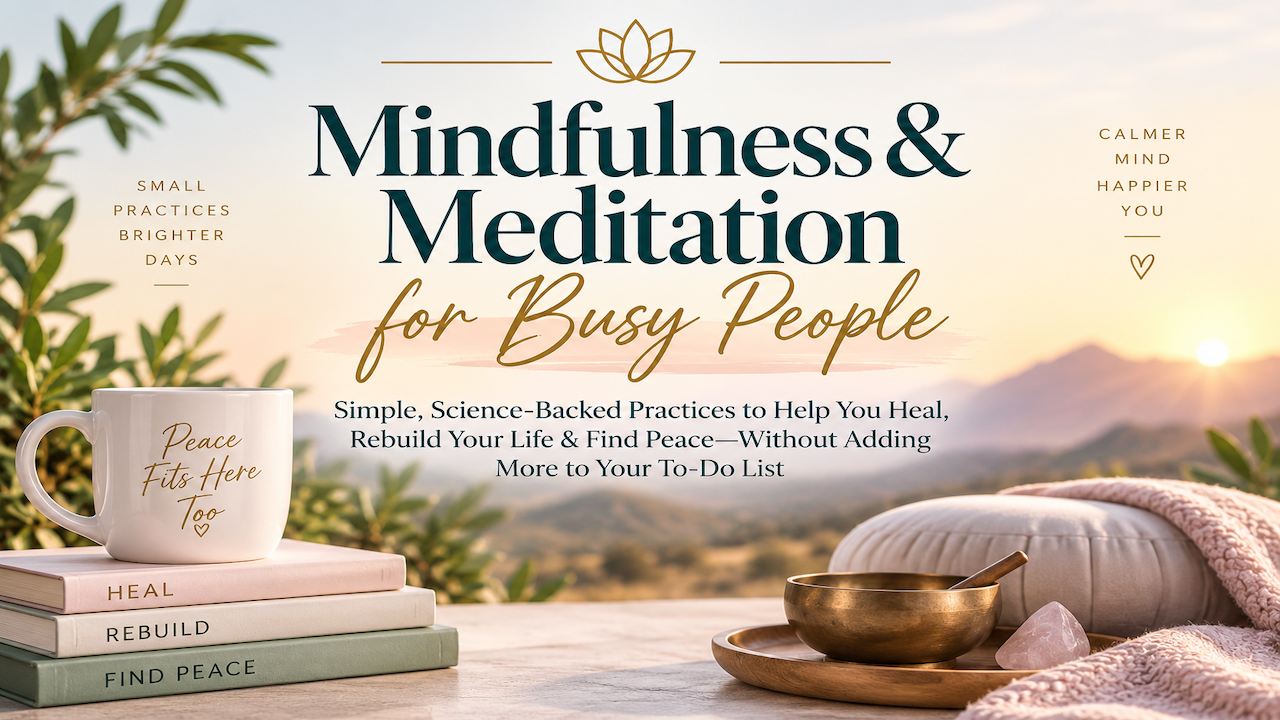
This is exactly why I created Mindfulness & Meditation for Busy People.
You don't need hours of free time, a perfectly quiet house, or years of meditation experience.
You just need simple practices that help you step out of autopilot and come back to the present moment, even in the middle of a busy life.
Inside the course, I teach the science behind mindfulness and meditation along with practical techniques you can actually use in your everyday life.
Because mindfulness isn't about escaping your life.
It's about being here for it. ❤️
Become a Wellness Warrior!
If you’re ready to start consistently learning about and implementing what I call micro-actions to upgrade your habits and heal as you rebuild your life, join The Wellness Vault and become a Wellness Warrior!

You are stronger than you think, and I believe in you.
All my love,

Progress, not perfection
References
Barnes, S., Brown, K. W., Krusemark, E., Campbell, W. K., & Rogge, R. D. (2007). The role of mindfulness in romantic relationship satisfaction and responses to relationship stress. Journal of Marital & Family Therapy, 33(4), 482–500.
Chen, P.-H., Tung, H.-H., Wu, Y.-C., & Sie, J. (2026). Effectiveness of savoring interventions: A systematic review and meta-analysis of randomized controlled trials. Applied Psychology: Health and Well-Being, 18(2), e70134.
Kiken, L. G., Lundberg, K. B., & Fredrickson, B. L. (2017). Being present and enjoying it: Dispositional mindfulness and savoring the moment are distinct, interactive predictors of positive emotions and psychological health. Mindfulness, 8, 1280–1290.
Voldstad, A., Zeas-Sigüenza, A., Skolzkov, A., Walthaug, M., Montero-Marín, J., & Kuyken, W. (2025). The effect of mindfulness interventions on couple relationship satisfaction: A systematic review and meta-analysis. Journal of Consulting and Clinical Psychology, 93(6), 427–442.