
The Neuroscience of Mindset: How Your Brain Influences Anxiety, Depression, and Healing
May 06, 2026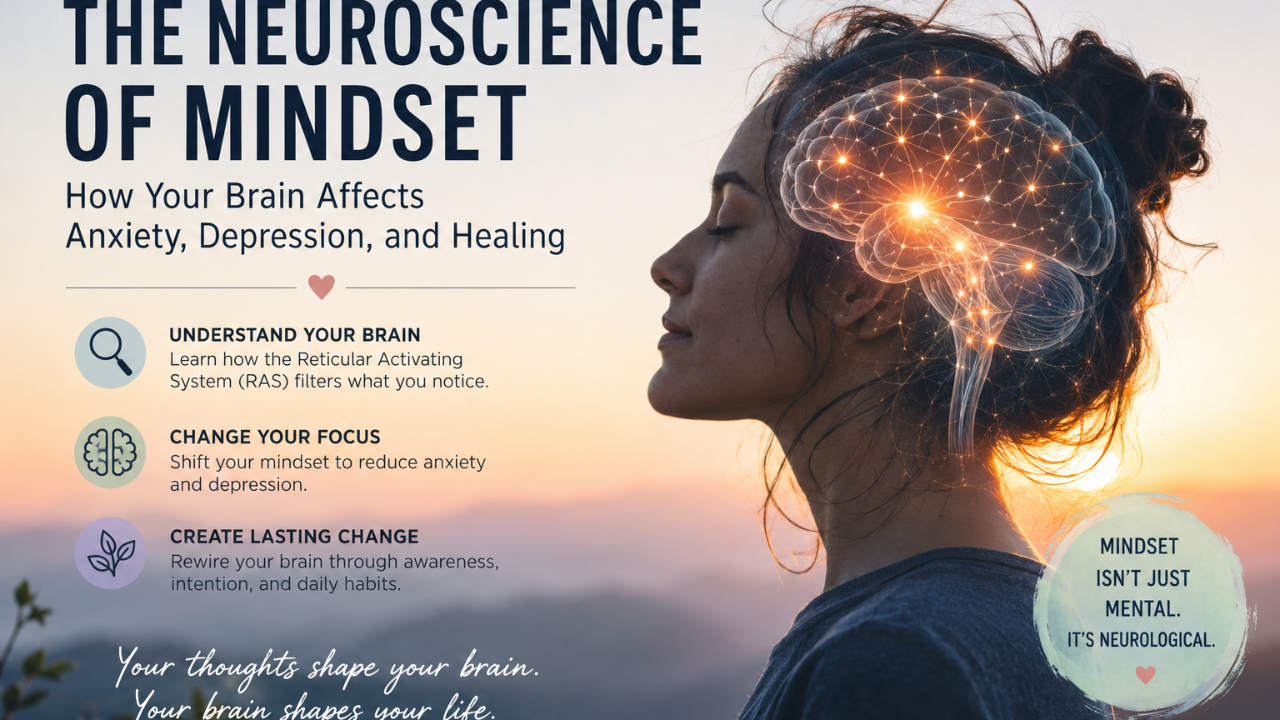
"Lose your mind and create a new one." ~ Dr. Joe Dispenza
If you’ve ever struggled with anxiety or depression, you know how easy it is to feel trapped inside your own mind. Negative thoughts can feel automatic. Fear can feel constant. And hopelessness can make it difficult to imagine things ever getting better.
What many people don’t realize is that there is actual neuroscience behind these patterns.
The brain is constantly learning, adapting, and reinforcing the thoughts we repeat most often. That’s why mindset work is so powerful, not because it magically erases hardship, but because it helps retrain the brain to process life differently.
One of the most important parts of the brain involved in this process is called the Reticular Activating System (RAS), and understanding how it works can completely change the way you approach mental wellness, personal growth, anxiety, and depression.
What Is the Reticular Activating System (RAS)?
The Reticular Activating System is a network of neurons located in the brainstem that acts as your brain’s filtering system.
Every second, your brain is bombarded with massive amounts of information: sounds, conversations, emotions, memories, distractions, sensations, and thoughts. Your RAS helps determine what gets brought to your conscious awareness and what gets filtered out.
In simple terms, your RAS decides:
- What you notice
- What you focus on
- What feels important
- What patterns your brain reinforces
And here’s the powerful part:
Your repeated thoughts and beliefs help program your RAS.
This means your brain begins searching for evidence that matches what you consistently focus on.
How the Brain Reinforces Anxiety and Depression
When someone experiences chronic anxiety or depression, the brain often becomes conditioned to focus on danger, failure, rejection, fear, or hopelessness.
This is not a personal weakness. It is a neurological pattern.
If your mind repeatedly thinks:
- “Something bad is going to happen”
- “I’m not good enough”
- “Nothing ever works out for me”
- “I’ll never feel better”
Your Reticular Activating System begins filtering for evidence that supports those beliefs.
You may start noticing:
- More negative interactions
- More reasons to worry
- More signs of failure
- More uncertainty
- More proof that reinforces fear or hopelessness
Meanwhile, positive experiences, opportunities, moments of peace, or evidence of progress can go largely unnoticed because the brain has not been trained to prioritize them.
This is one reason anxiety and depression can feel so consuming. The brain becomes highly efficient at spotting what confirms emotional pain.
Neuroplasticity: Why Healing Is Possible
The hopeful news is that the brain is not fixed.
Through a process called neuroplasticity, the brain can form new neural pathways throughout your life.
This means your thoughts, habits, emotional responses, and mindset patterns can change over time.
Every time you intentionally interrupt negative thought cycles and redirect your focus, you strengthen new pathways in the brain.
That doesn’t mean toxic positivity or pretending everything is okay. It means teaching your brain to look for balance instead of only danger.
For example:
- Instead of “I’ll never get through this,” you practice “This is hard, but I can take one step at a time.”
- Instead of “Nothing good ever happens,” you begin noticing small moments of support, peace, or progress.
- Instead of “Why is this happening to me?” you ask “What can I learn from this experience?”
These small mental shifts may seem insignificant, but neurologically, they matter.
Repeated thoughts become familiar pathways. Familiar pathways become automatic responses.
My Personal Experience with Mindset and Mental Health
There was a season of my life when anxiety completely consumed my thinking. I constantly expected worst-case scenarios. My mind searched for problems before they even existed.
At the same time, I experienced periods of emotional heaviness where everything felt difficult and overwhelming. Even when good things happened, my mind struggled to hold onto them.
Looking back now, I can see how strongly my Reticular Activating System was filtering my world through fear, stress, and discouragement.
I found myself constantly asking:
“Why is this happening to me?”
And because that was my focus, my brain continuously found more evidence that life was unfair, exhausting, and hopeless.
The shift didn’t happen overnight, but one of the most transformative things I ever did was begin intentionally changing the questions I asked myself.
Instead of:
- “Why does everything go wrong?”
- “What if I fail?”
- “What’s wrong with me?”
I started asking:
- “What is this teaching me?”
- “What can I control today?”
- “Where can I find support right now?”
- “What evidence do I have that healing is possible?”
Slowly, my brain began noticing different things.
Not perfection. Not constant happiness. But moments of hope, strength, resilience, connection, and growth that I had previously overlooked.
That shift changed my mental and emotional health in ways I never expected.
Why Mindset Work Matters for Mental Wellness
Mindset work is not about ignoring mental health struggles or pretending positive thinking cures anxiety or depression.
Therapy, medication, nervous system regulation, lifestyle habits, support systems, and professional care can all be incredibly important tools.
But mindset matters because your thoughts directly influence:
- Stress responses
- Emotional regulation
- Nervous system activation
- Behavioral patterns
- Motivation
- Self-worth
- Resilience
Your brain is always listening to the story you repeat most often.
And over time, that story becomes the lens through which you experience life.
Simple Ways to Retrain Your Brain
If you want to begin shifting your mindset and supporting your mental health naturally, start small.
1. Notice Your Default Thoughts
Pay attention to recurring thoughts without judgment. Awareness is the first step to change.
2. Ask Better Questions
Instead of asking disempowering questions, try:
- “What do I need right now?”
- “What can I learn from this?”
- “What is one small thing going well today?”
3. Practice Gratitude Consistently
Gratitude helps train the brain to notice safety, support, and positive experiences.
4. Limit Constant Negativity
Your brain absorbs what you repeatedly consume; social media, news, conversations, and environments all influence your mindset.
5. Be Patient with Yourself
Neural pathways take time to change. Healing is not linear.
Your Brain Can Change
Anxiety and depression can make it feel like your thoughts are permanent facts. But neuroscience tells us something important:
The brain is adaptable.
Your Reticular Activating System is constantly learning from what you focus on, repeat, and believe.
This means that even small mindset shifts can begin creating meaningful changes over time.
You are not powerless against your thought patterns.
With awareness, intention, support, and consistency, your brain can begin to recognize hope where it once only recognized fear.
And sometimes, healing begins with something as simple as changing the question you ask yourself.
You are stronger than you think, and I believe in you. You got this!
All my love,

Progress, not perfection